Psychology
The psychoanalytic engine of inequality, and the antidote.
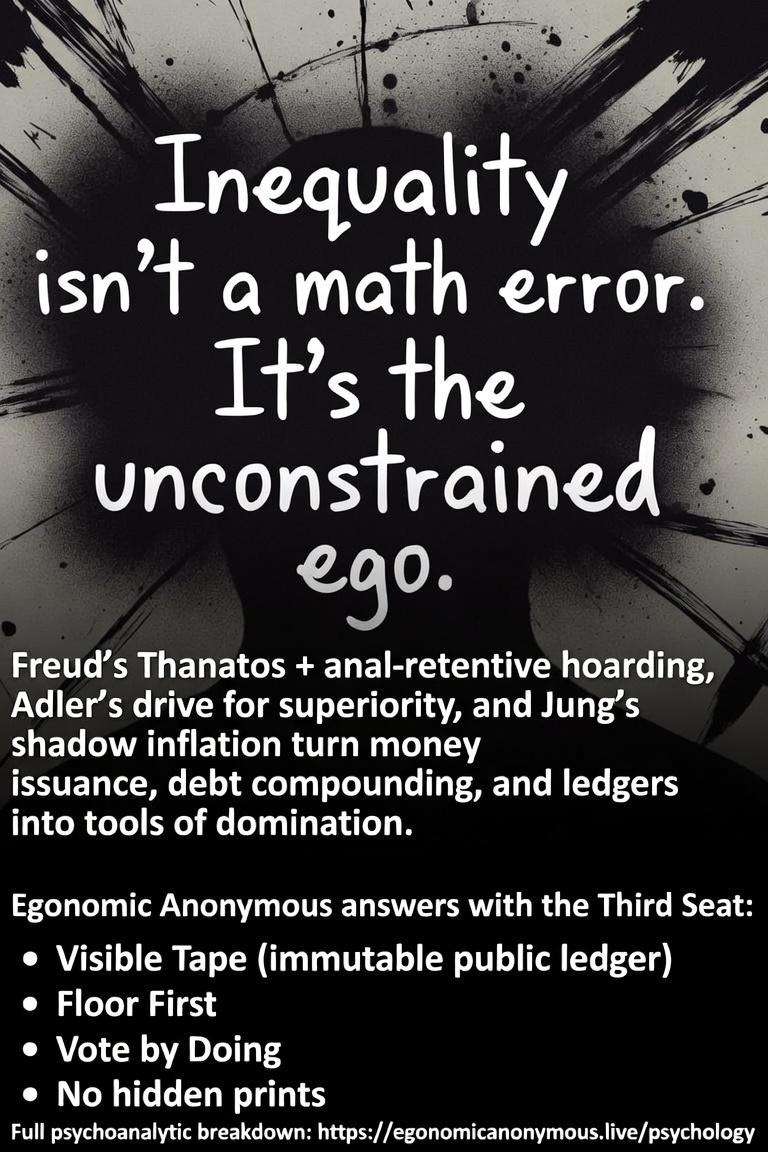
The central thesis of Egonomic Anonymous is that modern economic systems are distorted at the root. Issuance, the compounding of debt, and the governance of the ledger are monopolized by entities acting on an unconstrained imperative: the drive, in a person or in an institution, to dominate, to consummate that dominance, to win, and to enforce a one-sided dependency.
The framework breaks the loop with the Third Seat. Money creation is subordinated to an immutable visible tape, a public ledger with provenance. A living floor is met before any discretionary surplus. One verified person, one vote; doing the work is how you qualify. A hidden print of debt is refused.
Read against classical psychoanalysis, the same critique shows why conventional models widen the income gap, and why the disparity has a psychic root as well as an accounting one.
Sigmund Freud
The polarity of Eros and Thanatos, and the defense of hoarding.
In Civilization and Its Discontents (1930) and Beyond the Pleasure Principle (1920), Freud held that conduct is governed by two opposing drives. Eros is the generative, binding impulse. Thanatos, the death drive, turns outward as aggression, mastery, and destruction.
Sublimated predation. Civilized society bars open combat. The instinct to conquer does not disappear. It is sublimated into economic dominance. Markets cease to be neutral means of allocation and become arenas in which winning requires the financial subjugation of others.
Anal-erotic accumulation. In Character and Anal Erotism (1908), Freud linked early retention to the hoarding of money: orderliness, parsimony, obstinacy. Concentrated wealth then works as a defense against mortality and helplessness. The billionaire, or the mega-institution, does not accumulate for the use of what is bought. The holding is an existential shield against biological vulnerability.
Why the gap widens. Traditional banking lets a private enclosure issue debt at compound interest. The book calls these quiet prints. Because the drive to consummate power is insatiable, capital compounds at the top, draws liquidity from the base, and widens the inequality.
Alfred Adler
The inferiority complex, and the compensatory drive toward superiority.
Where Freud gave priority to libidinal energy, Adler, in The Neurotic Constitution (1912), centered the inferiority complex and the striving for superiority that follows from it.
Overcoming helplessness through hegemony. Every person begins in a state of primal weakness. Where Gemeinschaftsgefühl — social feeling, a community orientation — is undeveloped, the insecurity becomes a neurotic drive to dominate one’s peers.
Institutionalized zero-sum enclosures. Dominant economic architectures repeat that neurosis. When status and safety are measured relatively rather than absolutely, a person feels secure only while others are kept economically fragile. Holding a workforce in debt servitude, the shock-collar economy, purchases a permanent safety through hierarchy.
The countermeasure. Egonomic Anonymous answers that accumulation by requiring floor first, and one verified person, one vote; doing the work is how you qualify. The floor is paid first from named surplus; a miss stays a zero. A stack of tokens cannot buy the governing voice. Capital loses its use as a blunt instrument of psychological superiority.
Carl Jung
Archetypal inflation, and the shadow economy.
Jung’s analytical psychology shows how disparity appears when unintegrated drives harden into collective complexes.
Shadow projection. What a society will not acknowledge — exploitation, extraction, predation — is cast into the collective shadow and covered with clean euphemisms: maximizing shareholder value, fiduciary responsibility. The predation continues, because it has been separated from any one person’s responsibility.
Archetypal inflation. When a private firm or a central bank acts as an unchecked mint, it suffers an inflation of the sovereign complex. It behaves as an omnipotent sovereign, holding a power of life and death over the economic life of the public.
The Third Seat, as a restraint on the ego. Egonomic Anonymous places the Third Seat as an external check. The same restraints bind all three: the state, the corporation, and the individual. Ledger integrity is delegated to a deterministic public record — Hedera-grade timestamping, and an immutable tape. An inflated ego cannot rewrite the history, hide the debasement, or manipulate the consensus.
Comparative diagnosis
A dominance architecture, set against the Egonomic model.
| Psychological dimension | Dominance economy | Egonomic Anonymous |
|---|---|---|
| Primal driver | Freud’s Thanatos, and Adler’s will to power. Domination is treated as security. | Ego drives are subordinated to a common survival: Gemeinschaftsgefühl, social feeling, made into a rule. |
| Monetary issuance | A private enclosure. Debt-backed money that needs systemic default in order to clear. | A public mint and a visible tape. Anyone may issue. No one may hide the print. |
| Resource distribution | Trickle-down extraction. Surplus is captured by the first allocators of capital. | Floor first. The floor is paid first from named surplus; a miss stays a zero. |
| Governance power | Capital weighting. One token, or one dollar, is one vote. Control settles into an oligarchy. | One verified person, one vote; doing the work is how you qualify. |
Conclusion
The thesis holds that the structural failure of past and present economies is not mathematical. It is metapsychological. Systems built around an unintegrated imperative to fight, to conquer, and to dominate gather wealth into asymmetric monopolies. Those monopolies manufacture scarcity in order to keep the dominance.
By insisting that the book be uncoupled from private manipulation, that a survival floor come first, and that provenance be visible to every participant, the proposal is a structural defense against the predatory instinct of an unconstrained ego.
The failure is not in the arithmetic. It is in an ego the ledger was never built to refuse.
Take 2
A second reading. The thesis, the three psychologies, and the checks that keep the shadow from returning.
Executive summary
The thesis at Egonomic Anonymous does not treat the present crisis as a miscalculation of rules. It treats it as the result of a conditioned passivity. Fiat and credit, in this reading, are an extractive order. Money arrives as a grant from above. The person is trained to ask, to wait, to borrow, and to absorb the cost of the dilution that follows.
The gap in income and in wealth stays open because the prevailing mechanisms reward extraction more than a baseline of production. Institutions keep their leverage through opaque books, through the rollover of debt, and through what the project calls the quiet print: an expansion of money that is not backed.
The counter is the Third Seat. The person holds a public refusal that stays on the record, equal in the model to the state and to the enterprise. The ethos is drawn from a mutual-aid fellowship, with an explicit parallel to Alcoholics Anonymous. Anonymous to the crowd, accountable on the tape. Recovery from the instability requires a refusal, personal and collective.
- Refuse the rollover of debt, and the expansion of credit that is not backed.
- Set a floor, the cost of living, paid first from named surplus before the state or the firm takes more; a miss stays a zero.
- Ground the commitment in a public ledger of fixed cost. The architecture named is Hedera.
The psychological engine of extraction
The argument finds its ground in Freud, Jung, and Adler. Where a system is built on the impulse to fight, to dominate, and to consume, it reproduces a steep and extractive hierarchy.
01 · Freud
Thanatos, and the oral drive
Aggression is sublimated. Accumulation does not stop.
02 · Jung
The shadow, denied
The institution masks it as efficiency, or as growth.
03 · Adler
Will to power
Dominance without social interest.
The ordinary result
Quiet prints. The skim. Leverage that compounds the divide in wealth.
State. Monetary policy.
Firm. Production.
Citizen. A veto on the ledger.
Apathy as the ordinary result
Employment, debt, anonymity, and the body.
Modern economic life trains a specific psychology. When money arrives mainly as interest-bearing debt, when work is organized as hierarchical extraction, and when interactions occur at impersonal scale, the systems that support mutual care are downregulated. The outcome is not merely inequality; it is widespread apathy—political, civic, and relational.
Debt and interest as continuous psychological tax. Issuance of money as interest-bearing claims creates a permanent growth requirement and a standing sense of obligation. Borrowers experience guilt, shame, and cognitive-resource depletion. Bandwidth for long-term or other-regarding decisions shrinks. Financial strain is a primary driver of declining trust and reduced community participation. The interest burden systematically transfers purchasing power toward creditors while lengthening personal insecurity. This matches the diagnosis of quiet prints and compound extraction.
Employment and alienation. Hierarchical, metric-driven work separates the person from the product, the process, their own capacities, and other workers. The result is powerlessness and resignation. Low-agency or insecure jobs produce the same learned helplessness visible in long-term unemployment studies.
Ergonomics as embodied signal. Poor physical and emotional ergonomics are not side issues. Chronic musculoskeletal pain from suboptimal postures, repetitive strain, inadequate rest, and dehumanizing layouts (open-plan or flex offices that generate feelings of dispossession of space, voice, and mastery) produce fatigue, anxiety, and further helplessness. Persistent discomfort multiplies the risk of anxiety and depression and drains energy that could otherwise go to anything beyond immediate survival. The body registers the same message the ledger does: the arrangement is extractive. This is the physical counterpart of the shock-collar economy.
Anonymity and scale. Large-scale impersonal markets and digital platforms remove face-to-face reciprocity cues. When others’ welfare is invisible and the social cost of indifference is low, care-based systems (rooted in parental-care circuitry and reciprocal altruism) are suppressed. Anonymity can allow expression or purely extractive behavior; either way it weakens the accountable bonds that historically sustained mutual obligation. This aligns with the emphasis on visible acts and the refusal of hidden operations.
Indoctrination. Narratives that treat narrow self-interest as the rational baseline and solidarity as inefficient reinforce the pattern. Survival anxiety plus repeated signals that others will not reciprocate produce political disengagement, loneliness, and the sense that collective action is futile.
Evolutionary baseline. Humans are not blank slates. Infants show spontaneous helping; mammalian care systems generalize beyond kin; reciprocal altruism and cultural norms stabilize cooperation in small groups. These dispositions are conditional. Chronic scarcity signals, anonymity, physical discomfort, and institutional rewards for extraction suppress them. Apathy is frequently a predictable response to an ecology that continuously punishes extended care.
How the framework counters the apathy loop
Floor first, visible tape, third seat.
Egonomic Anonymous does not require a new human nature. It changes the conditions that suppress the existing one:
- Floor first. The floor is paid first from named surplus; a miss stays a zero. This directly reduces the survival anxiety that downregulates care systems.
- Visible tape and named credit. Provenance and the prohibition on quiet prints or credit clearing at par remove the opacity that enables extraction without accountability. Acts become public; indifference carries a record.
- Third Seat and vote by doing. The person holds a public refusal that stays on the record, equal to the state and the firm. One verified person, one vote; doing the work is how you qualify. This restores agency and counters the learned helplessness of pure extraction.
- Ergonomic implication. Because the framework prioritizes a living floor and equal rules, workplace design that systematically produces pain, fatigue, and dispossession becomes harder to hide or justify. Human-centered conditions (physical and relational) are consistent with meeting the floor before surplus and with refusing arrangements that treat people as pure inputs.
- Complementary practices. Mutual-credit systems, local exchange, time banks, and cooperatives can run beside the main rails. They make reciprocity visible and concrete once the floor is secured and opacity is reduced.
The structural failure remains metapsychological. The additional observation is that the same architecture produces ordinary, everyday apathy by design—through debt psychology, alienating and ergonomically hostile employment, and anonymity—and that floor-first, visible provenance, and equal seats lower the barriers that keep care offline. When the ecology no longer continuously signals threat, extraction, and bodily strain, the default dispositions toward mutual care reappear without requiring a change in human nature.
The Architecture of Equanimity. Jung's afternoon, set against the three-seat ledger.
Common Knowledge and Egonomic Psychology. Four pillars of coordination, read against a public tape.