
Take · Egonomic Anonymous
The man who asked the bunker a question
A magazine account of Douglas Rushkoff, the chip that died at dusk, and the clock that took its place.
After the conversation, his own shelf, and the note on peer-to-peer wealth. The comment from this house follows the piece. Team Human vs. Egonomics.
He does not introduce himself as an economist. On his own page he is an author and a documentarian, studying human autonomy in a digital age, through books, film, and talk. About twenty-five books. He named viral media before the word belonged to marketing. He made Merchants of Cool and Generation Like. He hosts Team Human. The book in the middle of this story is Survival of the Richest. The one his site is holding up now is Program or Be Programmed: move through the digital landscape with intention, or be shaped by it.
The interview starts earlier than the bunker. He began writing because he was interested in altered states, and because he thought the law was less afraid of the drug than of the seeing it allowed. Come back from that seeing and the agreements look optional. Why is this paper money. Why is that rent. Why do I work for him. He was a theater person who got tired of rooms that cost too much and ended the same way. The network was just then becoming a room anyone could enter. He wrote what email was, what a link was, what a virtual room might be, before most people believed the things were real. Then Media Virus, and the name stuck to him.
He watched the playground become a toll. The same tools that had let people show one another a vision were turned around, and used to install a vision in them. A podcast whose sentence is simple enough to keep: being human is a team sport. The only way out is through, and the only way through is together.
The research for the rich men’s book happened by accident. A hedge fund flew him out, business class, a car through the desert, a resort. In the green room he expected a microphone. Five very wealthy men sat down instead. At first the questions were bets. Then the question that was the real talk. Alaska or New Zealand. Where to put the bunker for what they called the Event. A pulse, a revolt, a climate, a plague. A world they had already decided would become unlivable, and a door that would close behind them.
He asked how they would pay the guards when the coin was already dead. Navy SEALs, they said, on a number they could call. They had planned the siege the way a show plans a season. They had not planned a Tuesday.
How do you pay the guards when the coin is already dead?
The chip that died at sunset
His history of money does not start with a bank. It starts late in the Middle Ages, after the wars had accidentally opened roads. People who had carried their crop to a lord began to stand in a market with one another. Shoes. Chickens. A blacksmith’s afternoon. The money between them was close to a chip in a game. Someone who held a real good issued it in the morning. By night it was finished. It had no ambition to be saved. It existed so the books could close.

He says people got rich in the only sense that mattered. They got well. A person doing well worked fewer days, because there was nothing sensible to hoard. The sign on the lane was not a vault. It was a short week. Wealth showed up as leisure. The chip could not invoice it.
The clock and the charter
The old lords had not worked in centuries. A middle class was a scandal. Rushkoff names two answers. One was the chartered monopoly: the crown’s friend becomes the only shoemaker, and every other hand comes by the hour. That is when employment begins. Work is older. The job is not. The clock goes up on the tower so the village can see the unit it is now selling. Time is money is not a folk saying in this telling. It is the hour the tower was built to announce.
The other answer was the end of the local chip. Trade, if you want it, by borrowing from the center, at interest, and returning more than you were given. The extra is not in the shop. It has to be grown into existence. From that day the society has to enlarge in order to stay solvent. New land, then a people taught to buy what they do not need, then a thing made to be thrown away, then a screen sold as infinite surface. People had only so many hours of looking. The last mine was attention.
They ran out of continents, so they opened the skull.
Beside the money he sets a way of knowing. What can be weighed is allowed to exist. What cannot is noise. A singer’s reach between notes can be corrected into a product. The correction removes the reason you were listening.
The wings

The bunker, in this account, is what the pyramid does when it can feel its own slope. A few humans, in the sermon he attributes to that world, are supposed to level up. Care spread sideways is treated as waste. The earth is a thing to leave. Most of us are the living that feeds the leaving. He notes that the sky they mean to cross is already crowded with the wreckage of the crossing. And the immortality on offer is not a life becoming more alive. It is a self, stored.
He does not make them one man. What is shared is the machine that rewards the person who cannot feel the cost. Wealth, the studies he cites, dims empathy after the fact. Some older arrangements kept a chief and also kept a circle that could unmake him. Ours pays the unmaking to stay undone.
There is a smaller scene he treats as the join. A human described as a computer for memes. A woman at the table asks after a soul. The table laughs. He takes her side and is dismissed as a moralist. Years later he draws the line he has been drawing since: if a person is only programmable matter, exploitation does not have to answer to anyone.
He does not end on a program for replacing the operating system overnight. He ends on conduct. One day a week, leave the screen. Meet someone. He calls the present hypernormal. The secrets are in large part public, and the public still clocks in, because a life still has to be paid for inside the clock’s week.
Sources
- Douglas Rushkoff, in conversation with Danny Jones, podcast #394, “I Was There”: Tech Elites Are Planning Breakaway Civilization, May 8, 2026. A later compilation is on YouTube as “He Exposed How the Elites Plan to Escape Humanity.”
- Douglas Rushkoff, rushkoff.com. Team Human. Survival of the Richest. Program or Be Programmed. Media Virus. Present Shock. Merchants of Cool. Generation Like.
- Douglas Rushkoff, Survival of the Richest: Escape Fantasies of the Tech Billionaires.
- Douglas Rushkoff, Team Human. The sentence he keeps: being human is a team sport.
- The note supplied with this assignment, “Forgot Peer-to-Peer Wealth.” Subtitle: Centralized Currency, Time-Clocks, and the Invention of Scarcity.
- Rufus Griscom, “Top 3 Highlights: Survival of the Richest with Douglas Rushkoff,” September 20, 2022. The same green room, told earlier.
Note
Team Human vs. Egonomics
A note set the two names against each other. Rushkoff’s side is his. The other name, in that note, is not this house.
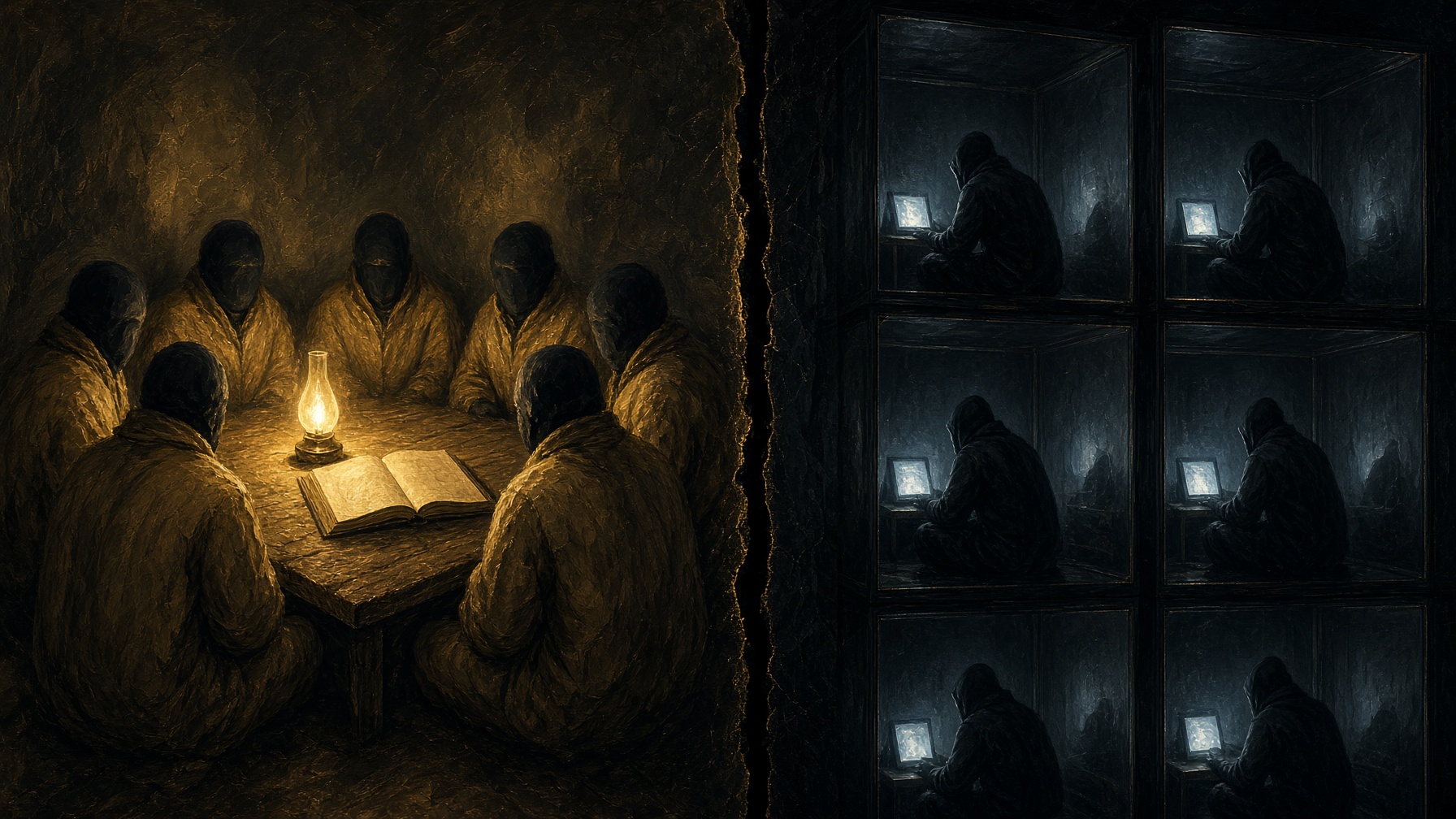
Team Human, as he uses it on rushkoff.com, starts from a person who is already with other people. The unit is the group, the room, the commons. The aim is flow, mutual aid, and a value that more than one person can hold. Paradox and a rough edge are signs of life, not faults. Step away from the screen and meet, and people steady one another. That meeting is what makes the extractive trick fail.
Egonomics, in the note, is the opposite machine. The word there means a person alone, managing a fight inside themselves between the want of this minute and a later aim. The platforms, the note says, were built for that fight. They strike the hot state. Scroll, buy, react. Isolation is the product, because a lone profile is easier to predict than a room. What does not fit the equation is treated as an error to be removed. The goal is performance, a clean forecast, and the sale of the attention.
The conflict, as the note draws it: the digital economy wants each person to see themselves as a node, tuning a name, a clock, and an appetite. Team Human is the refusal of that picture. Connection, ambiguity, and love count because a machine cannot finish the sum. The comment, above, is this house on the same ground.
This house does not answer to that second name. Egonomic here is the third seat. The person stands on the same floor as the state and the firm, and the line can still be shown. It is not the isolated ego, and it is not a product.