The symmetry rule
“Sovereignty is the refusal.”
Same rules. Same facilities.
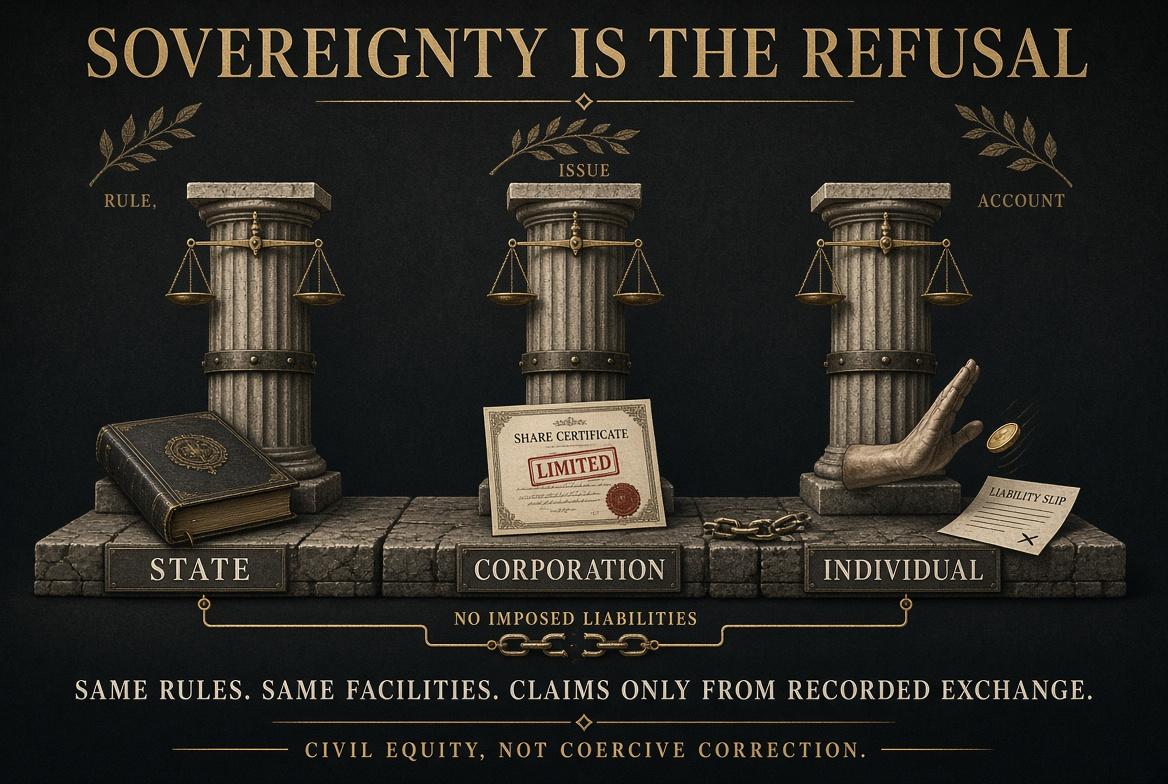
No imposed liabilities. Claims only from recorded exchange. Civil equity, not coercive correction.
Not a privilege of the state, and not a privilege of the firm. The same restraints, the same facilities, and the same accounting bind all three. Sovereignty is the shared power to refuse an imposition.
State, corporation, individual sit on one floor. None may write a rule it does not also live under. None may push a liability onto another without that other’s recorded consent. Settlement is civil and in equity. Force is what remains when the ledger is refused, not the way the ledger is written.
Final and absolute authority
Sovereignty simply means final and absolute authority. Therefore, those who have it are not subject to any outside authority on Earth.
The Declaration of Independence was the ultimate expression of the sovereignty of the people. This is exactly what Thomas Jefferson was expressing when he wrote, “Governments are instituted among Men, deriving their just powers from the consent of the governed.”
The people have the ultimate authority. The government is an agent of the people. The sovereign people can therefore “alter or abolish” the government as they see fit and institute a new government, “laying its foundation on such principles and organizing its powers in such form, as to them shall seem most likely to effect their Safety and Happiness.”
In this book the person is the third seat. Same rules bind all three. The refusal belongs to the people who keep the book.
The refusal is made durable by precommitment. Preferences reverse; the present self that sets a restraint will often want extraction later. External barriers—Floor first, public mint, named charge before residual, titled zero, “an unpublished change is not a change”—protect the book from the people who keep it. See the one-page field guide on the companion site.
Three actors
Rule
State
Originates base money and legal tender.
Lives under the same rule. A mint that is not on the tape is not a mint.
Issue
Corporation
Originates equity and debt against a limited shell.
A share is a recorded claim. Losses stay on the book. Credit does not clear at par.
Account
Individual
Originates nothing by declaration.
Same facility of refusal, in degree. Wealth rises only from a recorded exchange.
The offices are not the fracture.
The fracture is who may originate a claim.
| Office | Counterpart | What it does |
|---|---|---|
| Legislature | Rule-writer | Statute, charter, contract terms. Sets the facilities everyone must use, and live under. |
| Executive | Issuer | Treasury, central bank, corporate treasury. Puts claims into circulation. Does not hide the print. |
| Judiciary | Accountant of equity | Compels relative accounting. Unwinds an imposition. Force is the residual, not the default. |
Who may originate a claim.
The state originates base money. The corporation originates equity and debt against a limited shell. On this rule the individual originates nothing by declaration. Wealth on the floor rises only when a value exchange is recorded: performance against performance, not a printer.
Shares and central-bank liabilities are the two exceptions currently allowed to skip that step, then enforced on the third seat. The design stands or falls on whether those two are brought onto the floor, or left as privileges.
Refusal in degree.
A state already refuses a private claim. A corporation already refuses a creditor in bankruptcy. The individual counterpart is the same facility: decline an unconsented liability, a tax written as an imposition, or a monetary claim that was not earned by exchange. Matched, not unlimited. Absolute refusal collapses the common floor. Zero refusal is subjection.
Print is the same act.
Limited liability socializes the downside and keeps the upside. Central-bank issuance socializes the unit of account. If those are facilities, the individual needs the equivalent recorded claim: mutual credit, equity in the monetary base, or a refusal that zeroes an unearned liability. Otherwise the equity accounting never closes.
The hard edge is enforcement.
Civil equanimity works only while all three still accept the same ledger. The moment one actor can compel with violence and the others cannot, the offices stop being coordinate and become a hierarchy with a residual sovereign. Symmetry then requires one of two things. Coercive correction is unavailable to all three except through the shared equity court. Or the individual’s refusal is backed by the same remedy the other two already use.
Civil equity, not coercive correction.
One floor. Three actors. Claims only from recorded exchange. Liabilities only by consent. Refusal in degree. Settlement in equity.
#thirdseat · #egonomics · #providenceprovenance · #legomiego
The line can be shown · Third seat · The framework · Against fiat · Precommitment one-page